How to Seriously Grow Your Glutes

Glute growth sometimes requires a slightly different approach than other muscle groups. We break down the fundamentals of glute growth and cover some of the best glute exercises to help you build your ideal booty.
Key Takeaways
- Your glutes are composed of three different muscles.
- A protein-rich diet and resistance training with progressive overload are essential for growing glutes.
- Great glute exercises include squats, hip thrusts, and leg presses.
- You can also use machines, like the Roman chair and Smith machine.
- A professionally designed glute-growth workout program is a great option for enhancing your glutes.
See More: Do Workout Challenges Really Work?
The Secrets to Glute Growth
Carriejune, founder of Minibeast, says:
"Glute growth isn't complicated. Millions of people have grown their glutes with a structured fitness regimen and healthy, protein-rich diet."
Your glutes are the largest muscle group in your body. With the right training, you can grow them even larger.
Now, that doesn't mean glute development has to be complicated. It takes time, effort, and dedication, sure. But muscle hypertrophy, or growth, isn't magic. It's science.
With the right approach, you too can enhance your natural curves.
But what is the right approach?
That often varies between individuals. After all, two people following the same program could end up with very different-looking results. That's why many people choose to have a professional craft them a custom training and diet plan.
Still, there are some basic principles that can help you elevate your glute workouts. Before we cover those, we need to explain what your glutes are, exactly.
Understanding Your Glute Muscles
We often refer to the booty as a singular object. If you use the term glutes, you might think there are two.
In fact, your glute muscles are a group of three different muscles.
First, there's the gluteus maximus. It's the biggest of the three.
Next, there's the gluteus medius. It sits on the outside, toward your hip. It's important for hip abduction and hip stability.
Third and finally, there's the gluteus minimus. It lies beneath the other muscles, contributing to stability and rotation. Oh, and that classic lifted, rounded appearance.
These three muscles do a lot more than you might think. Your glutes play a role in basically every single lower-body movement, from walking to standing to lifting weights.
Weak glutes, in turn, can cause a range of issues.
One increasingly popular concern is pelvic tilt. Your gluteus maximus helps pull your pelvis down, so weakness contributes to anterior pelvic tilt. If your glute muscles and hamstrings are too tight, and your core and hip flexors are weak, you might experience posterior pelvic tilt.
Bonus: Do Fat Burning Creams Really Work?
The Science of a Killer Glute Workout

Now you know how your gluteus muscles work. So how can you actually grow them?
Before you step into the gym, there are a few fundamental principles you need to consider.
Proper Nutrition
Believe it or not, your diet might be the most important factor in growing your glutes. As Minibeast founder Carriejune says, "Diet is nearly 70% of our results."
That's because your body builds muscle after your workout, while you rest. It repairs the damage to your muscle fibers, ideally resulting in larger and stronger muscle mass.
That process requires energy and nutrition. You need to eat enough calories to provide the energy. And you need the right nutrition to give your body what it needs to repair and recover.
The repair process requires protein for muscle synthesis. Experts generally recommend trying to eat between 0.7 and 1 grams of protein per pound of body weight every day. You should spread your protein intake out throughout the day, rather than trying to pack it all into a single killer meal.
Protein powder is a great way to hit your protein goals. Consider using a high-quality protein isolate, which is designed to contain less fat, sugar, and carbs than standard protein powders.
Heavy Weights
A common mistake people make when trying to train their glutes is not using enough weight. Remember, your glutes are powering your whole body. To be challenged, they need serious resistance.
Of course, that doesn't mean packing the barbell with more weights than you can physically handle. It means you should be really challenging yourself, pushing your glutes to their limit.
Progressive Overload
Over time, your glutes should adapt to those heavy weights. That's the entire point of a strength training program.
Therefore, in order to keep developing, you need to keep increasing the resistance your glutes are facing. This principle is called progressive overload. Experts often recommend keeping a diary or journal of your workouts so you can track your progress and ensure you are progressing efficiently.
One simple way to increase resistance is by adding more weight. It's not the only method, though. You could also reduce the time you rest between sets, add extra sets, increase your range of motion, or perform an exercise for more reps.
Rep Range
That said, you might not want to perform sets of endless reps. Doing so could take ages and probably isn't the most efficient way to train.
Experts generally recommend aiming for a rep range of between 8 and 12 reps for muscle growth.
However, that's not necessarily a strict guide. Instead, the more important thing is effort. You should be training to failure, which means training until you can't complete another rep with good form.
In one 2026 study, two groups of people trained their lower bodies to failure. One group did 10 reps in each set, while the other did 20 reps per set. Both groups had similar changes in muscle strength and growth.
Correct Form
You'll notice we defined failure as the point at which you can't do more with good form. Form is absolutely crucial.
Good form helps keep the load on your glutes. That has two benefits.
First, it means you're actually training your glute muscles, instead of other parts of your body. Second, it protects potentially vulnerable parts of your body, like your spine, from injury.
Glute Activation
Another important thing to consider is your mind. No, seriously.
When training your glutes, you should try to focus on activating them during each rep. Really focus on them, and on preventing other muscles from taking over.
This principle is called the mind-muscle connection. Research suggests that it can help enhance a muscle group's activity during a workout.
Warm-up or activation exercises can help you build this connection. Examples for glute workouts include donkey kicks, clamshells, hip extensions, and glute bridges.
Glute Exercises for Building Muscle and Size

Those basic principles are important no matter what exercises you do. But what exercises should you do?
To some extent, that's up to you. It can be a good idea to vary your workouts, as it can keep things interesting and help you stay dedicated to your strength training program.
That said, there are certain exercises that are often recommended for people who want serious glute development.
Hip Thrusts
Barbell hip thrusts are arguably one of the best glute exercises out there. They are a core component of many people's glute workouts, and for good reason.
For one thing, hip thrusts place your glutes under resistance through a full range of motion, which is fantastic for effective muscle growth. Of course, that relies on you using proper form.
For hip thrusts, sit on the floor with your upper back resting on a bench (or similar). Place your barbell on your hips, using a cushion or pad if necessary to prevent pain.
Once you're ready, drive your hips upward, pushing through your heels and activating your glutes, until your upper body is parallel with the floor. Try squeezing your glutes extra hard at the top of the movement for an extra boost.
Then lower your hips back down in a controlled manner. That's one rep. Now repeat.
You can also perform hip thrusts at home, using a dumbbell or weight plate or similar instead of a barbell. The movement is the same.
Leg Press
The leg press is a fantastic machine for glute development. It's quite simple, making it a great option for beginners. You can load it up with some serious weight, which also makes it a potent option for seasoned glute-growers.
Sit on the backrest and place your feet on the platform in front, called a sled. Your feet should be high on the platform, a little wider than shoulder width, and your toes pointed a little outward.
When you're ready, unlock the safety handles and begin. Lower the weight in a controlled manner until you have your knees bent at a 90º angle. Then press through your feet to push the sled back, making sure to channel through your glutes as you push.
Make sure not to fully lock your knees at the end of the motion. Keep a very slight bend in them.
The leg press is also more versatile than you might think. Small variations in your foot placement can change the emphasis of the movement.
Split Squats
Squats are perhaps the most famous exercise for building glutes. Split-leg squats are a fantastic unilateral exercise.
There are a few advantages to unilateral exercises, which means exercises that train a single leg instead of both at once. You can use them to address muscle imbalances. They also allow you to increase the resistance on one leg without increasing the weight you use too much.
Split squats also let you work on using each side of your body independently. Your body has to use stabilizer muscles to stay upright during the motion, too.
Beginners can start with bodyweight squats. You might be surprised at how difficult they are with just your bodyweight! Over time, you can use dumbbells or barbells to increase the resistance.
Start with one foot in front and the other behind. When you're ready, lower your back knee toward the floor. Try to keep your front shin vertical and your back straight. You can lean forward a little to help activate your glute.
Next, squeeze that glute to rise back up, driving through your front heel.
Bulgarian Split Squats
Another fantastic single-leg glute exercise is the Bulgarian split squat. The secret lies in keeping your back foot elevated.
Put your back foot up on a bench, sofa, or something else stable. Your laces should be facing down.
Next, bend your front knee to lower your hips down toward the ground. Then, use that front standing leg, and specifically the front glute, to drive yourself back up to your starting position.
Sumo Squats
Sumo squats are a killer squat variation that helps target your inner thighs and glutes. Instead of the normal stance, you spread your legs out wider with your toes pointed outward.
The rest of the movement is like a normal squat. Lower yourself down, keeping your chest tall and ensuring your knees stay in line with your toes. Make sure to squeeze your glutes while driving back up to your starting position.
This is a particularly great home glute workout.
Roman Chair
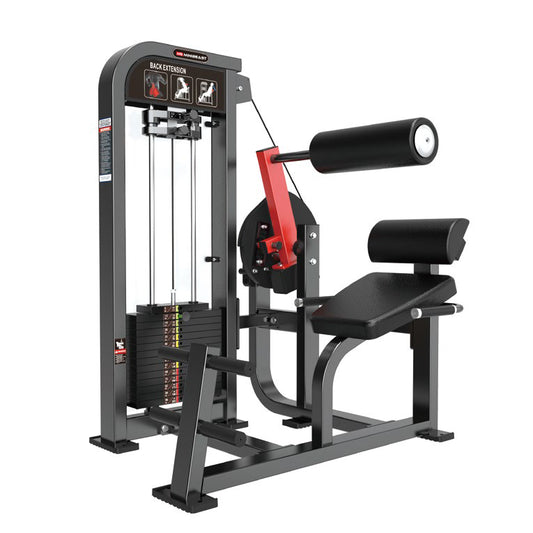
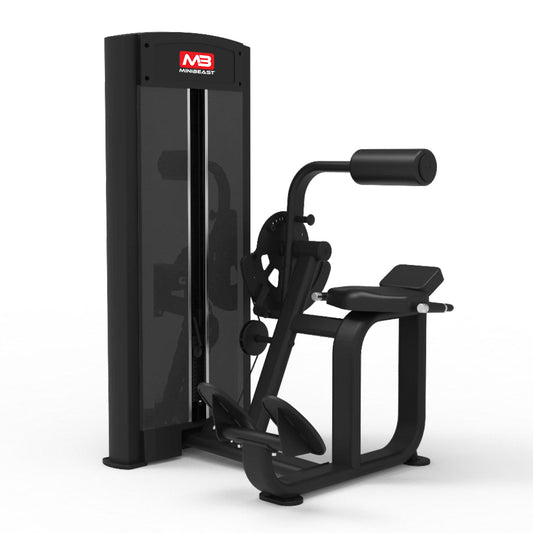
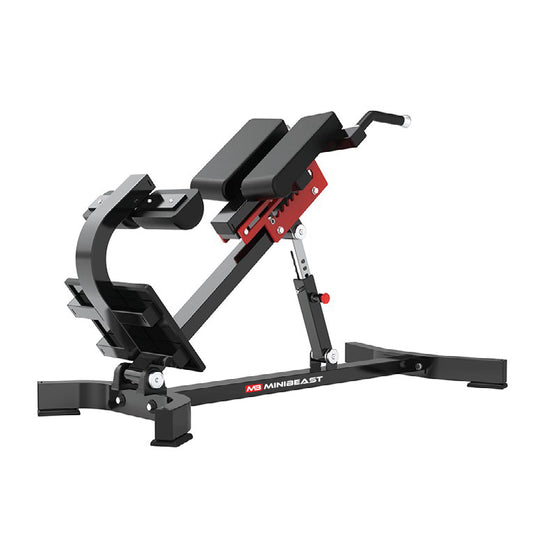
The Roman chair, also called a back extension machine, is an underrated tool for building your glutes.
Why? Because it puts your glutes under strain while they are extended. That's something lots of other glute exercises don't do.
The Roman chair is also a great way to train your spinal support muscles and hamstrings.
To start, place your hips in the machine, making sure you're facing forward. Hinge forward, lowering your upper body with control. Then drive back up.
The key is to make sure you're using your glutes to drive your descent and ascent. If you want extra resistance, try holding a weight.
Minibeast's Back Extension machine and Horizontal Roman Chair machine are two great options if you want to integrate these exercises into your home gym routine.
Smith Machine

The Smith machine is another fantastic piece of equipment for glute training. Its secret lies in parallel metal rails, to which a barbell is fixed.
These rails keep the barbell on a fixed straight path, effectively balancing the weight for you. This reduces the chance of injury from the bar tipping, slipping, or falling. It's a great way for beginners to learn a movement, people recovering from injury to get back into lifting, or attempting a particularly heavy weight.
You can perform all kinds of glute-building exercises on a Smith machine. Squats, Bulgarian split squats, hip thrusts, deadlifts... the list goes on.
Minibeast's Ultra Series Smith Machine is a sleek, durable option for guided weightlifting. You can actually use it to train your entire body, making it a versatile machine.
Glute-Building Training Program
All of the above exercises and machines are fantastic ways to build your glutes. But it can take time to figure them all out, especially if you've never tried them before.
If you aren't sure where to start or feel like your training has plateaued, you might want to try a training program. Make sure to pick a high-quality, professionally designed program that's designed with all the key exercises you'll need to grow your glutes.
Minibeast's Booty & Legs Workout Program is exactly that. You'll get workout plans, recipes, and personal tips from Carriejune herself, plus a range of other resources to help you develop and sculpt your glutes.
Conclusion
There are plenty of excellent glute exercises out there. Consistent training with progressive overload, plus a healthy diet rich in protein, is the core to any successful glute-building fitness program. And essential if you're aiming to be a fitness model or just feel better about your shape! Following a professionally designed program is also a great option.
Frequently Asked Questions
How Long Does It Take to Grow Glutes?
With proper training and diet, you might start to see visible results within several weeks. Long-term muscle development can take longer, and is often measured in months.
What Is the Fastest Way to Gain Glutes?
Experts generally recommend following a resistance training program structured around consistent progressive overload, combined with a caloric surplus and a protein-rich diet. A professional workout program designed for glute growth is a great option.
What Is the 8-8-8 Rule for Glutes?
The 8-8-8 rule is a method for enhancing your hip thrusts. You perform eight hip thrusts, then eight pulses near the top of the range of motion, then hold at the top for eight seconds. Make sure to squeeze your glutes as hard as you can during the hold.
Keep Reading: What Is a Waist Trainer? Does Waist Training Work?
-
Minibeast believes that everyone has the power to evolve into their best self. From state-of-the-art fitness equipment to comprehensive training programs, our brand is built for those who take their goals seriously. Through The Heart of Minibeast, 5% of every order helps feed families in need and support community programs. Get the latest workout tips, product updates, and fitness content by following us on Instagram, Facebook, YouTube, and TikTok.
–
These statements have not been evaluated by the Food and Drug Administration. These products are not intended to diagnose, treat, cure, or prevent any disease. The information provided on this website is for informational purposes only and is not intended as a substitute for professional medical advice, diagnosis, or treatment. Always seek the advice of a qualified healthcare provider with any questions you may have regarding a medical condition or before starting any new diet, exercise program, supplement, or using any fitness equipment or apparel. By using this site and its products, you acknowledge that you do so at your own risk. Use all products only as directed and discontinue use immediately if discomfort or adverse effects occur.