15 Best Exercises for a Booty Workout at Home (No Weights Required)

If you think you need a gym membership or a full set of weights to build the booty of your dreams, think again. We break down how you can build an effective booty workout at home.
Key Takeaways
- Building your glutes provides many potential benefits beyond aesthetics, such as enhancing athletic performance and improving whole-body stability.
- The key is keeping your glutes challenged with progressive overload.
- You can increase the challenge of bodyweight exercises by performing them slower, adding a hold or pulse, or using a resistance band.
- Movements that target your glutes include squats, lunges, hip thrusts, and step-ups.
See More: Yes, Working Out Can Count as a Hobby!
A Booty Workout at Home That Actually Works
Carriejune, founder of Minibeast, says:
"It's totally possible to get major booty gains at home. The secret lies in doing the right exercises, and doing them well."
If you've been looking into building muscle, you might have heard people say you need to lift heavy weights to do it. After all, your glute muscles are among the largest in your body, so it makes sense they'd need heavy weights in order to grow, right?
Not so fast.
It's entirely possible to get a fantastic booty workout at home, even without any weights. The key is doing the right exercises, doing them properly, and doing them consistently.
Of course, that's easier said than done. If you're trying to come up with a booty-building workout routine at home, you're in the right place. We'll demonstrate some of the very best exercises for doing just that, and explain the fundamentals of resistance training that will help you smash your fitness goals.

Introducing Your Lower Body's Biggest Muscle Group
Before all that, it's worth knowing what you're working with. Your glute muscles are a muscle group, not a single muscle. There are three muscles within the group, each with its own particular functions.
Gluteus Maximus
Your gluteus maximus is the largest of the three glute muscles. In fact, it's one of the largest muscles in your entire body.
This formidable muscle is the primary factor behind your booty's shape and size. It powers all kinds of lower body movements, especially hip extension, which is the movement you make when driving your hips forward.
A strong gluteus maximus is important for keeping your upper body stable and upright.
Gluteus Medius
On the outside of your gluteus maximus, near the side of your hip, is your gluteus medius. It's primarily responsible for keeping your pelvis stable, especially when you're standing or exercising on just one leg. It also helps control your thigh rotation.
As you might know, many lower body movements, both in and out of the gym, involve some kind of single-leg component. That makes the gluteus medius far more important than you might think at first. A weak gluteus medius often manifests as knee instability or hip drop, so it's important to keep it strong.
Gluteus Minimus
Underneath your gluteus medius is the smallest of your three glute muscles, the gluteus minimus. It may be small, but it's still mighty.
Your gluteus minimus also works to keep your hips stabilized and under control during single-leg or rotational movements. It also helps keep your pelvis level.
Potential Benefits of Building Your Glute Muscles
You might already be able to see some of the many potential benefits of strengthening and growing your glute muscles.
There's the aesthetic component, of course. But your glutes provide many more benefits than mere aesthetics.
Strengthening your glute muscles can enhance your lower body strength, giving you more power in all kinds of fundamental movements and enhancing your overall athletic performance.
As we mentioned, your glutes play a key role in stabilizing your body. Strong glutes therefore help improve spinal alignment and posture, which can help take some pressure off your lower back. They can also help support the rest of your lower body, potentially reducing the risk of injury during other exercises.
Training your glutes can also enhance hip mobility and flexibility, which is useful both inside the gym and during daily life.
Ultimately, glute exercises can do so much more than build a booty. They can help you build a stronger body from the bottom up. (Pun intended.)
Bonus: How Waist Trainers Help with Posture & Support

The Fundamentals of a Good Glute Workout
Now, all that is easier said than done. In order to build your glutes, you need to approach glute exercises in the right way.
For a booty workout at home, the most important principle to remember is progressive overload. In order to make your muscles adapt and grow, you need to challenge them. As they adapt and grow, you need to increase the resistance they face in order to maintain that challenge.
In the gym, that usually means increasing the weight you use. If you have weights at home, like a set of adjustable dumbbells, you can use that method. But it's not the only one.
You can also make glute exercises more challenging by performing more reps, doing them more slowly, adding isometric holds, and switching to single-leg variations.
No matter what kind of exercise you do, try to maintain your mind-muscle connection. That means really focusing on your glutes, intentionally and consciously squeezing them during each rep rather than going through the motions.
Don't forget your core muscles, either. Keeping your core braced helps protect your lower torso, especially during intense movements.
Experts often recommend aiming for two or three glute workouts per week. That gives your muscles sufficient stimulus to grow, while also giving them enough rest to actually recover and repair.
Try to start each workout with a warm-up. It doesn't have to be intense; five minutes of active stretching and basic movements often does the trick. A warm-up helps increase blood flow, activate the glutes, and prepare you for the workout. It is important to prevent injury.
Good form is also critical to prevent injury. Pay close attention to your form and never sacrifice it to try to push out an extra rep.
A cool-down is also a good idea. You could do some simple static stretching to reduce post-workout tightness and keep everything feeling good.
It's also worth incorporating a variety of exercises into your booty-building workout routine. For one thing, that can keep things interesting and prevent boredom or burnout. It also makes sure you're hitting each of the three glute muscles, plus the other muscles that support them.
15 Best Glute Exercises to Build Your Booty at Home
#1. Glute Bridge
The glute bridge is a staple of booty workouts both in the gym and at home. It's a great beginner workout, and a fantastic warm-up exercise for more advanced lifters.
Your starting position for a glute bridge is lying on your back with your feet flat on the floor and your knees bent. Engage your core to keep your back straight, then push through your heels to lift your hips upward.
Make sure to focus on squeezing your glutes, especially at the top of the movement. Then, slowly lower your glutes back down to the floor.
If that feels a little too easy, there are plenty of variations that make things more challenging. For instance, you could do a single-leg glute bridge. It's basically the same thing, but using just one leg (and one set of glute muscles) to lift your hips instead of both.
Another option is to elevate your feet. Put them on a step, box, chair, or sofa. Any sturdy, stable surface will do. The movement itself is the same.
If you have a resistance band, try looping it around your thighs, just above your knees. That should increase the intensity of the movement.
#2. Hip Thrust
Hip thrusts are another staple glute exercise. It's scarily effective at targeting your gluteus maximus through the full range of motion when extending your hips.
Start by sitting on the floor with your upper back leaning against a stable surface, like a bench or sofa. Keep your feet hip-width apart and flat on the ground in front of you. Your knees should be bent.
When you're ready, squeeze your glutes and drive your hips upward until your upper body and thighs form a straight line. Try pausing at the top of the motion, giving your glutes an extra squeeze to maximize effectiveness. Then slowly lower back to the starting position and repeat.
It's important to keep your core engaged throughout your hip thrusts to protect your lower back.
Increasing the resistance in hip thrusts is simple. If you have a weight, hold it on top of your hips. Otherwise, add a resistance band around your knees. You can also perform the whole movement more slowly, which increases the time your muscles are under tension.
#3. Curtsy Lunge
Curtsy lunges are a great choice for targeting your gluteus medius. It’s one of the most underrated exercises for a booty workout at home. Beyond all the benefits we described already, building your gluteus medius can make your booty appear more rounded and reduce the appearance of hip dips.
Start standing with your feet hip-width apart. Then, move your right leg behind your left leg, bending down until your back knee (your right knee) nearly reaches the floor. Press through your heel, squeezing your glutes, to push up and return to your starting position. Switch legs and repeat.
Make sure to keep your hips square and your upper body upright throughout the whole range of motion. Control is more important than speed during a curtsy lunge.
If you want to add more resistance, try adding a pulse at the bottom of the movement.
#4. Split Squat
The split squat is another fundamental glute-building exercise. Beyond building muscle, split squats also help train your stability and balance.
Start standing with your feet shoulder-width apart. Place your right foot forward and your left foot back. Bend your knees, keeping your torso upright. Your back knee should go down toward the floor while your front knee bends over your front foot, without traveling too far forward.
Then press up through your front foot, squeezing your glutes to drive back up to the starting position. Repeat and then switch legs.
Adding weights is an easy way to make split squats more difficult. If you prefer going weightless, try adding an isometric hold at the bottom of the movement. That means pausing and holding, keeping your muscles contracted.
#5. Step-Up
Chances are, you do step-ups every day. Every time you climb stairs, you're doing step-ups. Practicing this movement is therefore a great way to build functional strength.
All you need is a sturdy platform. A step or box works great. Stand in front of the platform, place your right foot on it, then press through your right heel to lift your body up.
Try not to jump or push with your left leg. You don't need to actually step onto the platform; just tap the top with your left foot before lowering yourself down in a controlled manner.
One way to increase the difficulty of step-ups is by raising the height of the platform. Alternatively, try adding a pulse or hold at the top of the movement.
#6. Bulgarian Split Squat
This simple variation of the split squat is a fantastic way to challenge your glutes. The secret is elevating your back foot. Doing that makes your front leg work even harder.
Stand in front of your surface (a bench or sofa should work fine) and place the top of your back foot on it. Lower your back knee, keeping your front leg's shin vertical. Then press through your front heel to push yourself back upright.
As with regular split squats, you can slow down the movement or add a pause at the bottom to increase the difficulty without weights.
#7. Glute Kickback
This exercise doesn't require any weights, but you will need a resistance band. Kickbacks are fantastic for isolating your gluteus maximus.
Attach your resistance band to your ankle on one end and a solid anchor point on the other end. The leg of a sturdy couch could work.
Lean forward slightly, then use your glute to pull back the leg with the band attached to it. Keep your standing leg firm.
#8. Donkey Kick
Donkey kicks are similar to glute kickbacks, except you're on all fours (sort of like a donkey) and your working leg has a bent knee throughout the movement.
Start on all fours. Keep your working leg's knee bent at about 90 degrees. Lift your working foot upward, squeezing your glutes, then lower back down. Don't let your knee actually touch the floor before repeating.
Placing a resistance band around your knees or ankles is a great way to up the challenge. It can also get the gluteus medius involved.
#9. Goblet Squat Pulse
We've already mentioned the concept of pulsing to increase difficulty. Pulses increase the amount of time your glutes are under tension. They're a great addition to goblet squats.
For goblet squats, start standing with your feet shoulder-width apart. Keep your toes pointed a little outwards. Brace your core, then bend your knees and hips to lower yourself down, keeping your chest tall.
Once your thighs are parallel to the floor, it's time to pulse. If you can go a little lower, go for it, and if you aren't flexible enough to get that far, just go as far as you can manage with good form. Once you've pulsed, drive back up and repeat.
#10. Superman
It's a bird! It's a plane! Nope. It's just a fantastic bodyweight exercise that trains not only your glutes but your entire posterior chain. That means glutes, lower back, erector spinae, and more.
If one of your goals with your glute workouts is improving your posture and overall stability, this is a must-add.
Start by lying face down, extending your legs and arms straight out. Lift both your chest and legs off the ground at the same time. Squeeze your glutes and lower back, but keep your neck neutral.
Try holding at the top of the movement or add a few pulses to make things trickier.
#11. Squat Jump
Adding some explosiveness to your movements can provide unique benefits. This is called plyometrics, and it's thought to enhance muscle power and coordination. It's also a great way to improve how high you can jump and how fast you can run, if that's of interest.
Start by doing a normal squat. But once you reach the bottom, instead of rising back to standing, explode upward with force, jumping up and landing softly back in your normal squat position.
As you might expect, this is a higher-impact movement than those we've discussed so far. It's therefore particularly important to warm up beforehand.
#12. Romanian Deadlift
Romanian deadlifts are a fantastic hip-hinge exercise that targets both your glutes and hamstrings.
Start standing, then move your hips back to lower your torso forward. Keep your back flat and a slight bend in your knees. When you feel a stretch in your hamstrings, squeeze your glutes to drive your hips forward to the starting position.
#13. Lunge to High Knee
Pairing multiple movements is a great way to hit different muscles and keep things interesting. The lunge to high knee is a dynamic combination that helps train balance and power, as well as build your glutes.
Start as you would for a normal lunge. Step your front leg forward into the lunge. Instead of returning to standing as normal, drive through your front foot, lifting your front knee up to your chest.
#14. Burpee to Squat
Here's another dynamic exercise combination. Adding a burpee or half-burpee to your squats is a fantastic way to get your heart pumping and add some full-body goodness to your glute workout.
Start by squatting as normal. When you reach the bottom of the squat, place your hands on the floor in front of you, kick your feet back into a plank, then jump forward back into your squat.
#15. Straight Leg Deadlift Pulse
This is a variation of the Romanian deadlift, where you add a small pulse to the bottom of the movement. It increases the time under tension for your glutes and hamstrings. Make sure to keep things slow and controlled.

More Resources for Building a Booty at Home
We've covered the basics of building a booty and described a bunch of fantastic exercises that can help you do just that. But putting all that information together into an effective workout plan can still be tricky.
Fortunately, there are plenty of additional resources out there that can help you turn your motivation and newfound knowledge into a solid booty-building workout plan.
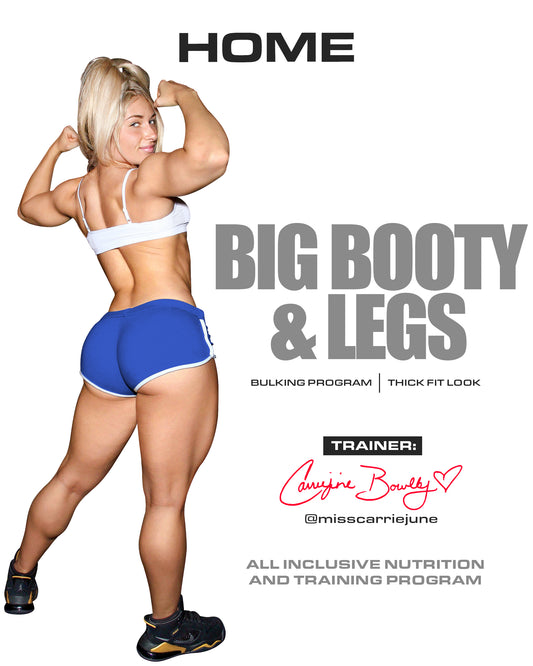
Minibeast's Standard "Big" Booty & Legs program gives you all the secrets Carriejune used to build her legs and booty. This program is designed specifically for people looking to max out their booty, the "hard gainers" who want size and strength as fast as possible.
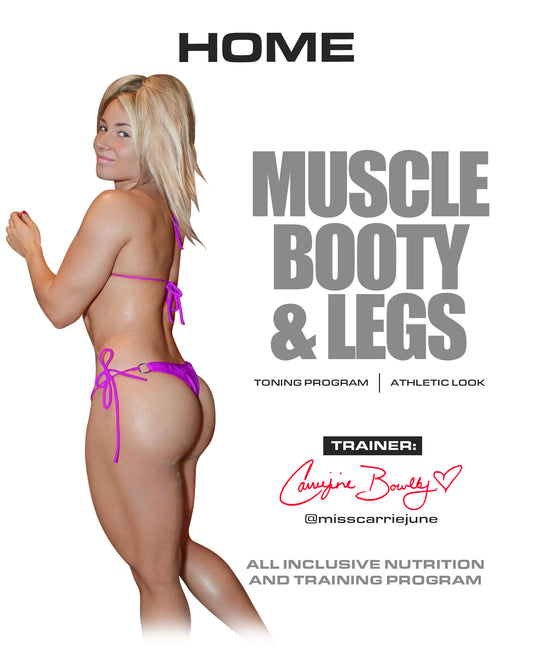
If you prefer keeping things tight and toned, try Minibeast's Standard "Muscle" Booty & Legs program. It balances building muscle and strength with burning fat and toning everything.
Both workout programs give you 8 full weeks of workouts that change halfway through, tailored meal plans, personal tips, and much more.
Another great technique to jumpstart your booty-building journey is joining a workout challenge. Minibeast's 8-Week Workout Challenge gives you access to five full workout programs, customized calories and macros, a 24/7 private support group, meal plans, demonstration videos, and much more.
That's why hundreds of thousands of people have used it to supercharge their fitness journey.
Conclusion
It's entirely possible to get a great booty workout at home, with or without weights. Make sure to push yourself, maintain good form, and follow progressive overload to keep making progress.
Frequently Asked Questions
How Do I Build My Booty At Home?
To build your booty at home, do a targeted glute workout two or three times per week. You can use bodyweight exercises like squats, hip thrusts, and lunges. Alternatively, add weights or resistance bands to increase the challenge.
Is a 10-Minute Booty Workout Enough?
That depends on your goals. 10 minutes is definitely enough to see benefits to overall fitness and wellness. But it might not be enough to see major muscle growth.
Can I Tone My Bum In 2 Weeks?
Two weeks isn't usually long enough to see major changes to your muscle size or definition. You might see minor improvement, though. Two weeks is definitely better than no weeks, and puts you two weeks closer to seeing major changes.
Keep Reading: Can Pre-Workout Be Used for Weight Loss?
--
Minibeast believes that everyone has the power to evolve into their best self. From state-of-the-art fitness equipment to comprehensive training programs, our brand is built for those who take their goals seriously. Through The Heart of Minibeast, 5% of every order helps feed families in need and support community programs. Get the latest workout tips, product updates, and fitness content by following us on Instagram, Facebook, YouTube, and TikTok.
–
These statements have not been evaluated by the Food and Drug Administration. These products are not intended to diagnose, treat, cure, or prevent any disease. The information provided on this website is for informational purposes only and is not intended as a substitute for professional medical advice, diagnosis, or treatment. Always seek the advice of a qualified healthcare provider with any questions you may have regarding a medical condition or before starting any new diet, exercise program, supplement, or using any fitness equipment or apparel. By using this site and its products, you acknowledge that you do so at your own risk. Use all products only as directed and discontinue use immediately if discomfort or adverse effects occur.