A Woman's Guide to Picking the Right Dumbbell Weight

Much of the advice out there for picking the right weight is designed for men. But women often need to make different choices to progress properly.
Read on for some things you should consider when choosing the perfect weight.
Key Takeaways
- Choosing the right weight is important for getting a good workout, progressing toward your fitness goals, and avoiding injury.
- It's often better to start lighter and move up if that doesn't provide enough of a challenge.
- For strength training and muscle building, you should be struggling to complete your last few reps with good form.
- Women tend to have a higher concentration of their lean body mass in their lower bodies.
- Lower body workouts therefore often require heavier weights than upper body workouts.
See More: What Is a Waist Trainer? Does Waist Training Work?
Choosing the Perfect Dumbbells
Carriejune, founder of Minibeast, says:
"To have a great workout and progress efficiently, you need to use the right weights. Lighter weights are generally better for beginners and upper body exercises, while heavier weights are often more suited to advanced lifters and lower body workouts."
When it comes to working out, the most important thing is getting started. But how can you do that if you don't know what weight to use?
It's a question that has troubled many a beginner and stumped even experienced lifters. Choosing the right dumbbells can make the difference between an effective or lackluster workout. It can affect how fast you progress and even influence your risk of injury.
Too light, and you might not see the results you want. Too heavy, and you risk slipping into poor form and even becoming injured
In short, picking the right weights to use is crucial. That choice might be more complicated than you think. It goes beyond simply choosing the heaviest weight you can manage.
Let us break it down.
Step One: Your Fitness Goals

Before you touch a dumbbell, it's worth considering what exactly you want to achieve.
What are your fitness goals? Do you want to pack on serious muscle mass? Are you trying to lose fat? Or do you just want to have fun and improve your overall fitness?
There isn't necessarily a right answer. Remember, your fitness journey is yours and yours alone. The important thing is to try to be clear about what that goal is, because that will determine how much weight you lift.
Losing Fat
If your goal is to lose weight, there's really no need to reach for the heaviest weights. Instead, experts usually recommend picking a moderate weight. Think something that you can perform at least a dozen reps of with good form.
The goal here is to get your heart pumping and keep your muscles working. Try pairing your lifting with a calorie deficit and cardio.
Using moderate weights for more reps is also a great way to improve muscle tone and endurance.
Strength Training and Building Muscle Mass
The approach for strength training and muscle building is different. Here, you want heavier weights and fewer reps.
Typically, workout plans call for sets of 6 to 10 reps. You should really struggle on the last two reps. That doesn't mean slipping into poor form, though. The aim is near-failure.
The key is maintaining progressive overload. As your muscles grow, you need to increase the weight to keep them working hard.
A good sign you need to up the difficulty is if you start to find your current weight easy throughout the whole set. If that's the case, consider increasing the weight by between 2% and 10%.
This steady, consistent progress is the secret to serious strength and muscle growth.
Bonus: How to Seriously Grow Your Glutes
Step Two: What You're Training

The next thing to consider is what part of your body you're training.
After all, different muscle groups can handle different volumes of weight. You'll likely be able to squat far more than you can curl, for example. As a result, you need to tailor your choice of dumbbell based on the muscles you're targeting that session.
Upper Body
Your upper body muscles include your biceps, triceps, chest, and shoulders.
In general, they're suited to lighter weights. They tend to be smaller than your lower body muscles and often tire faster.
Starting with lighter weights also helps protect your joints. Going too heavy can risk you slipping into poor form and getting injured. It's far more important to maintain proper technique through every single rep than trying to lift heavier loads than you can actually handle.
For women, experts often recommend starting with dumbbells in the 5 lb to 10 lb range. That's especially true for people just starting out, as it gives you space to nail the proper form.
With compound exercises involving multiple muscles, you might be able to lift more. For example, Strength Level's community benchmarks estimate that the average one-rep max bench press for beginner women is 38 pounds. For intermediates, that rises to 111 pounds.
Another way of looking at weights is by comparing them to your bodyweight. To stick with our example of bench presses, a beginner might aim for a weight-to-bodyweight ratio of 0.25 times. As you progress, that ratio should increase.
Lower Body
Some of the strongest muscles in your body are concentrated in your lower body. Your glutes, for example, are your largest muscles.
After all, your lower body muscles are responsible for carrying you around all day. Sitting, standing, walking, running — it's all thanks to your lower body muscles.
This is especially true for women. Research shows that women tend to have more of their lean mass, or muscle mass, in their lower limbs.
As such, your lower body muscles can generally handle heavier weights than upper body muscles.
Let's use Strength Level's squat community benchmarks for a comparison. For beginners, the average is 65 pounds, or a bodyweight ratio of 0.5 times. That's significantly higher than for the bench press.
How Much Weight to Use

If you're still unsure what specific weight to pick, don't worry. Figuring that out is actually quite simple.
Your Own Bodyweight
First, don't discount bodyweight training. You can get a serious workout with just a mat, your own bodyweight, and maybe some resistance bands. Even a workout waist trainer can help!
If you find exercises difficult when using only your bodyweight, you might not be ready to tackle dumbbells just yet. That's absolutely fine. Just keep working at it, and you'll progress.
Lighter Weights
The next step is lighter weights. There's nothing wrong with reaching for a small dumbbell, especially when you're starting out.
In fact, it's actually the smart approach. With a light weight, you can practice a movement, perfecting the form and ensuring you're primed to tackle heavy weights in the future.
Starting with a light weight is also a great way to figure out the right dumbbell to use. If you aren't sure, pick a light dumbbell and try performing the exercise you want to do.
How did that feel? If you breezed through the entire set, chances are you need a heavier dumbbell. Think about it as if you just did a warm-up set and move on.
If it felt too difficult, or you didn't make it to the last few reps, you might have set your sights too high. That's also fine. Just move down to a lower weight and get a great workout in.
And if it felt just right? Congratulations, you just completed your first set. Take a rest and prepare for the next one.
Heavier Weights
As you progress, you'll need to increase the weight you use. That's central to the concept of progressive overload that we discussed earlier.
Heavy dumbbells can be more dangerous. If you're unsure, you might want to work with a personal trainer or physical therapy professional. They'll be able to help you develop good form and pick the perfect weights for your specific body composition, ability, and fitness goals.
Another great option is joining a professional workout program. Minibeast's 8-Week Workout Challenge, for example, gives you access to multiple workout programs and fitness routines based on your goals, plus video demonstrations to help you get started.
What Weights to Use
We've discussed how to pick the perfect weight. But what about picking the perfect weights?
If you're in the gym, you'll likely have access to a wide range of equipment. But if you're choosing what equipment to buy, you need to know some of the most common options.
Adjustable Dumbbells
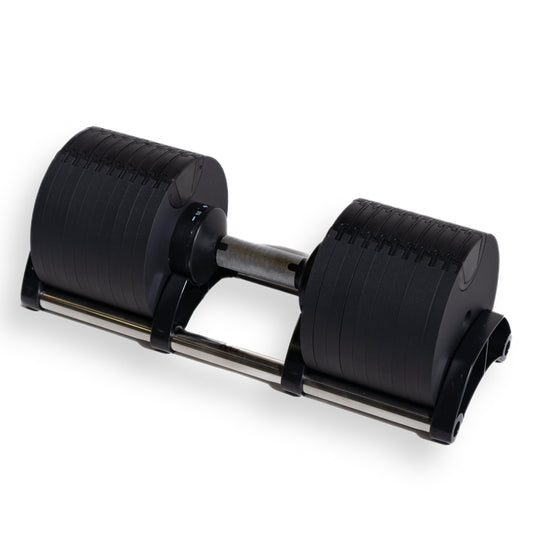
If you're trying to save space, few things are better than a set of high-quality adjustable dumbbells. Imagine a whole set of traditional dumbbells, compressed into a single compact tool.
Minibeast's Adjustable Dumbbells range from 10 lb to 100 lb. You can switch between different weight settings in seconds, with a simple twist of the handle. All major parts of the dumbbell are made from cast iron and aluminum for durability, and a unique stress-bearing structure ensures the adjustment system and handle never bear force.
Cast Iron Dumbbells
The traditional choice is cast iron. These dumbbells are durable and reliable.
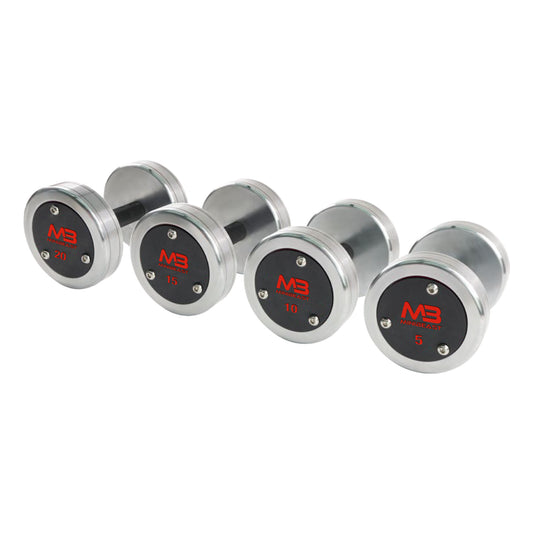
Minibeast's CNC Stainless Dumbbells come in a wide range of weights. If you're a beginner, consider grabbing the 5 lb and 10 lb options. As you progress, you can upgrade to the 15 lb, 20 lb, and 25 lb options.
Beyond that, the weights get serious. They go all the way up to 150 lb.
Rubber Dumbbells
Rubber dumbbells are another excellent choice for home workouts. The rubber makes them gentler on floors. It also helps reduce noise when setting the weights down.
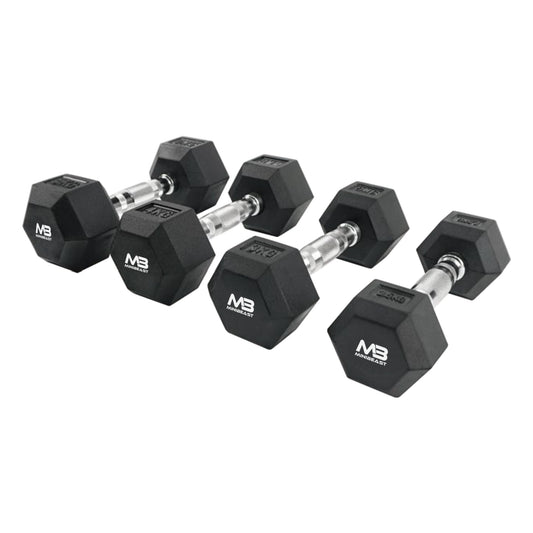
Minibeast's Rubber Hex Dumbbells have a hexagonal design, which helps prevent them from rolling around when set down.
They have an even more precise range of lighter weights, too, making them a great option for beginners. If you're starting out, grab the 2.5 lb, 5 lb, 8 lb, and 10lb options. For intermediates, try the 12.5 lb, 15 lb, and 20lb options.
That doesn't mean these dumbbells don't get heavy. They do: Up to 130lb.
Conclusion
Dumbbells are the ultimate workout tool. Choosing the right ones to use is crucial for an effective workout and efficient progression. Beginners should start small and work their way up, always remembering to maintain proper form.
Frequently Asked Questions
What Is a Good Dumbbell Weight for a Woman?
That depends on your goals, what muscles you're working, and what exercises you're completing. In general, beginners should aim to start with 5-10 lbs for upper body exercises and 10-20 lbs for lower body exercises.
Are 10-Pound Dumbbells Good for Women Beginners?
Yes, 10 lb dumbbells are widely used by beginners to build strength and muscle. Of course, it depends on your personal fitness levels and which muscles you're working. For certain exercises, like squats, you might need more weight.
What Weight Dumbbells Should I Use to Tone My Arms as a Female?
Lighter weights are often better for arm workouts compared to lower body workouts. That's especially true for women, who tend to have a higher concentration of their muscle mass in their lower body. Many women use 2.5 lb to 12 lb dumbbells to tone their arms.
Keep Reading: Is It Better to Eat Before or After a Workout?
--
Minibeast believes that everyone has the power to evolve into their best self. From state-of-the-art fitness equipment to comprehensive training programs, our brand is built for those who take their goals seriously. Through The Heart of Minibeast, 5% of every order helps feed families in need and support community programs. Get the latest workout tips, product updates, and fitness content by following us on Instagram, Facebook, YouTube, and TikTok.
–
These statements have not been evaluated by the Food and Drug Administration. These products are not intended to diagnose, treat, cure, or prevent any disease. The information provided on this website is for informational purposes only and is not intended as a substitute for professional medical advice, diagnosis, or treatment. Always seek the advice of a qualified healthcare provider with any questions you may have regarding a medical condition or before starting any new diet, exercise program, supplement, or using any fitness equipment or apparel. By using this site and its products, you acknowledge that you do so at your own risk. Use all products only as directed and discontinue use immediately if discomfort or adverse effects occur.