When Should I Increase My Dumbbell Weight?

Knowing when to increase your dumbbell weight, and by how much, can make the difference between efficient progress and stagnation. We break down the specifics to help you smash your fitness goals.
Key Takeaways
- Progressive overload is the foundation of effective strength training.
- It calls for continually increasing the resistance your muscles face, so they are continually challenged.
- The most common way of doing this is by increasing the weight you use.
- If you can surpass your rep target during your last set, you might need to increase the weight you use.
See More: Should I Wear Gloves When Weight Lifting?
The Secret to Building Strength
Carriejune, founder of Minibeast, says:
"The key to strength training is ensuring your muscles are challenged, so they continue to adapt. That means increasing your dumbbell weight once an exercise becomes too easy."
If you've been lifting weights for a while, but your progress has stalled, there's often a simple solution.
Use heavier weights.
No, seriously. Muscle building relies on a concept called progressive overload. In order to continue making progress, you need to continually challenge your muscles.
Using the same weights time and time again simply won't cut it. Eventually, your muscles will get used to the weight. Unless you just want to stay active or lose weight, your progress will stall unless you switch something up.
However, you shouldn't wait until your progress stalls to switch weights. That's not particularly efficient, and it'll get frustrating quick.
Instead, experts generally recommend increasing weight when the final few reps of your set stop feeling like a true challenge.
But how, exactly, can you tell when that's happening? And how much should you increase the weight each time?
We'll explain all that and more. First, we need to break down why progressive overload is so important.

Effective Strength Training
Building strength and muscle is all about adaptation. When you repeatedly put your muscles under strain, they gradually adapt.
During an intense workout, your muscle tissue will develop tiny tears. During recovery, your body repairs that damage, theoretically building your muscles back bigger and stronger than before.
Over time, that progress means the same weights should start to feel easier and easier. That's your body adapting to the challenge.
Bonus: How Many Sets Per Workout Should I Do?
How Progressive Overload Leads to Strength Gains
If you don't then increase the challenge, your body will eventually finish adapting. That's where progressive overload comes in.
The idea behind progressive overload is consistently increasing the resistance your muscles face. That can come from performing more reps. It can come from reducing rest time between sets.
But the most classic way of increasing intensity is increasing weight.
Remember, your body has no inherent need to build strength and muscle. It won't do so unless you force it to.
Starting With Light Dumbbells
Of course, that doesn't mean jumping straight to the heaviest dumbbell you can physically lift. That's a recipe for injury.
Instead, you should use the weight that's right for you. Beginners in particular should start with lighter weights. Doing so will give you the space to learn proper form, which will serve you well when you progress to heavier (and more dangerous) weights.
The good news for beginners is you probably won't stay with those lighter weights for long. Many beginners will increase weights every 1-2 weeks. That initial progress can be an excellent motivator, though be aware that this pace of progress won't last forever.
Intermediate lifters, for example, might increase weights every 2-4 weeks, or even longer. Elite lifters might only increase the weight they use by a few pounds over the course of an entire year.

The Last Set
Generally, experts recommend aiming for 8-12 repetitions of an exercise for strength training.
The reason that's a range and not a specific number is that the effort you put in is more important than the specific number of reps you do. Ideally, you want to finish each set close to failure.
Now, that never means sacrificing good form. Proper form is essential, both for ensuring your workouts are actually targeting the right muscles and to avoid injury. Your workouts should be challenging, but never so much as to undermine form.
A common principle for measuring sets is called reps in reserve. It calls for finishing sets with 1-3 reps left in the tank. In other words, when you feel like you're on the brink of failure but not quite there, finish your set.
What if you can't even make it to 8 reps? If you're breaking down too early, you might need to stick with your current weight for longer or even switch to a lighter weight to avoid injury.
What if you breeze all the way to 12 reps with no problem? Doing so is a good sign you might be ready to advance.
One simple way to determine when you're ready to move up is the two-for-two rule. If you can finish two more reps than your goal in two consecutive workouts, it's time to increase the weight.
How Much Weight to Add
This doesn't mean doubling your dumbbell weight. Instead, upgrade in small increments.
The key is consistency. Consistent upgrades are what prevent plateaus in training. Over time, they compound into visible results, while sudden jumps put you at greater risk of injury.
The precise increase depends on a few factors.
For example, different muscle groups may be able to handle different increases. For upper-body exercises, consider increasing the weight by 2.5-5 lbs per dumbbell. Lower-body exercises, which generally involve larger muscle groups, might require an increase of 5-10 lbs.
Similarly, compound movements involve multiple muscle groups. They therefore often allow for faster weight increases compared to isolated movements, like bicep curls or lat raises.
Sometimes, it's better to increase weight in really small increments. If you're using barbell movements, fractional plates allow you to increase the weight by 1 or 2 lbs for precise adjustments.
Ultimately, the key to progression is to push yourself near fatigue while not sacrificing good technique. Doing that with consistency is one of the most successful strategies for muscle growth and strength gains.
Where to Get High-Quality Dumbbells

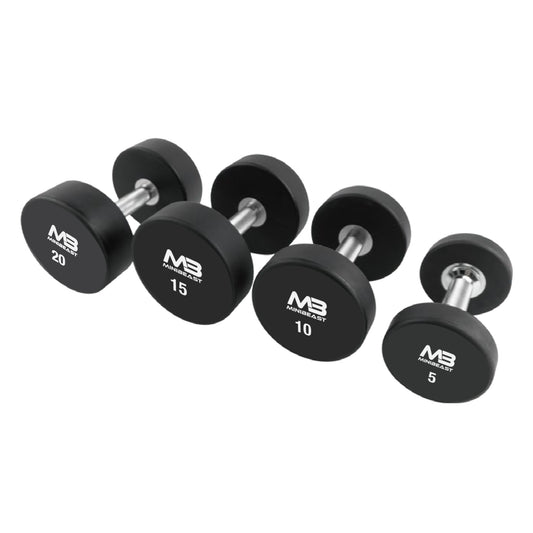
Dumbbells are one of the best ways to maintain progressive overload. They come in a wide variety of weights, so you can continually increase the load your muscles face over time. And you can use them to perform hundreds of different exercises, targeting all your major muscle groups.
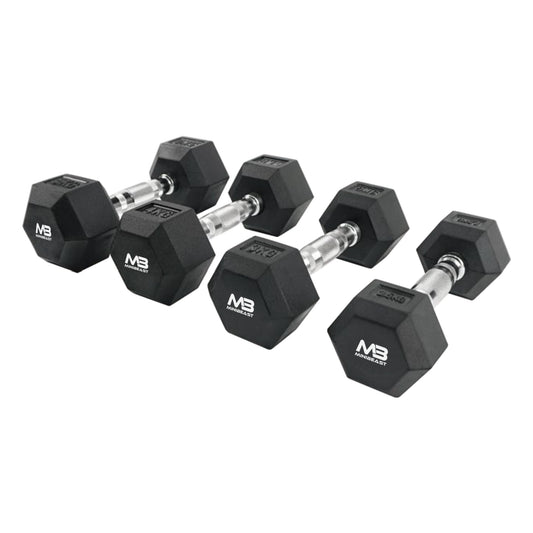
If you want to build strength and size with dumbbell progressions, consider grabbing a set of high-quality traditional dumbbells. Minibeast's Rubber Hex dumbbells are a great choice for home gyms. They range from 2.5 lbs to a hefty 130 lbs. The hexagonal rubber weight plates are great for stacking and protecting floors.
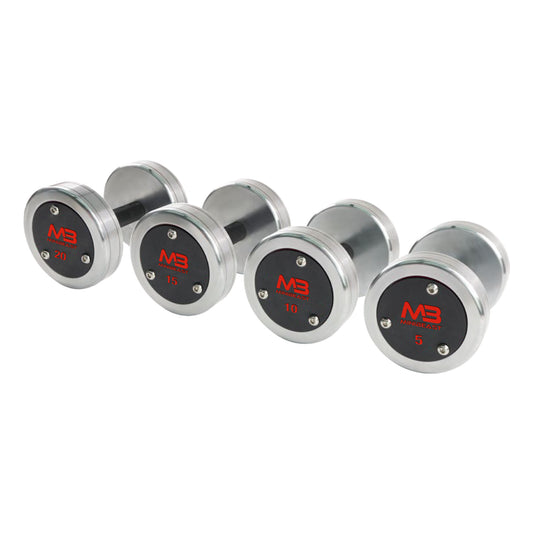
For something a little heftier, grab Minibeast's Signature CNC dumbbells. They're the ultimate traditional fixed-weight dumbbell, ranging from 5 lbs to a whopping 150 lbs.
If you are looking to use these dumbbells at home, you might be wondering where to fit them all. Gyms have the space for entire racks of weights. But you might not have that in your home gym.
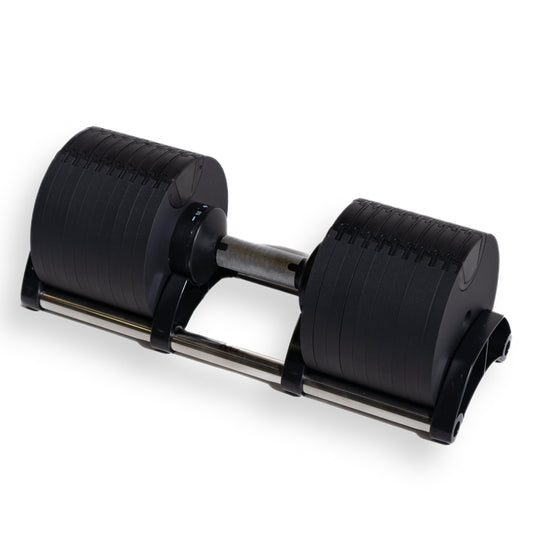
For the ultimate space-saving alternative, grab an adjustable dumbbell. A single adjustable dumbbell can replace an entire rack of traditional dumbbells, ranging from 10 lbs to 100 lbs. You can switch between each weight with a simple twist of your wrist.
Conclusion
You should generally increase the weight you use once you are able to complete a few extra reps with good form. Ideally, you should be pushing yourself close to failure. Once that stops being the case, it's a sign you need to up the challenge to ensure your muscles are still being forced to adapt.
Frequently Asked Questions
What Is the 3-3-3 Rule for Workouts?
The 3-3-3 rule is a simple workout framework. Each workout involves three circuits, each circuit three exercises, and each exercise three sets.
Is a 35 lb Dumbbell Considered Heavy?
That's relative and depends on many factors. A beginner attempting an upper-body isolation exercise, like bicep curls, will likely find 35 lbs far too heavy. But an experienced lifter hitting a lower-body compound movement, like a squat, will likely find 35 lbs very light.
What Is the 2-2-2 Rule in the Gym?
The 2-2-2 rule, or two-for-two rule, is a straightforward guideline for weight progression. Once you're able to complete two more reps than your target during your final set, in two consecutive workouts, you need to increase the weight.
Keep Reading: Here's Why You Should Wear a Waist Trainer While Working Out
--
Minibeast believes that everyone has the power to evolve into their best self. From state-of-the-art fitness equipment to comprehensive training programs, our brand is built for those who take their goals seriously. Through The Heart of Minibeast, 5% of every order helps feed families in need and support community programs. Get the latest workout tips, product updates, and fitness content by following us on Instagram, Facebook, YouTube, and TikTok.
–
These statements have not been evaluated by the Food and Drug Administration. These products are not intended to diagnose, treat, cure, or prevent any disease. The information provided on this website is for informational purposes only and is not intended as a substitute for professional medical advice, diagnosis, or treatment. Always seek the advice of a qualified healthcare provider with any questions you may have regarding a medical condition or before starting any new diet, exercise program, supplement, or using any fitness equipment or apparel. By using this site and its products, you acknowledge that you do so at your own risk. Use all products only as directed and discontinue use immediately if discomfort or adverse effects occur.