What Dumbbell Weight Is Best for Men?

Picking the right dumbbell weight can make the difference between a great workout and a bad one, or worse, an injury. We break down the three factors you need to consider to help you pick the perfect weight every time.
Key Takeaways
- Different dumbbell weights are right for different people and situations.
- Building muscle often requires heavier dumbbells, while fat loss or general fitness often requires lighter dumbbells.
- Larger muscle groups, like in your lower body, can handle heavier weights.
- Compound exercises also usually require heavier weights compared to isolation exercises.
- It's often a good idea to start with lighter weights, as you can always move higher if needed.
See More: Cardio vs. Weight Lifting: Which Is Better for Weight Loss?
Picking the Right Dumbbell Weight
Carriejune, founder of Minibeast, says:
"To pick the right dumbbell weight, think about three things: Your fitness goals, what muscles you're exercising, and your current fitness level."
It's often said that the hardest part of a fitness journey is the first step. One of the things that can make that first step so hard is not knowing where to start.
To a seasoned lifter, a dumbbell rack represents opportunity. Dumbbells are among the most versatile tools in the gym. They can be used for hundreds of different exercises, covering every major muscle group.
But if you're a beginner, all those weights might seem more intimidating than inspiring. If you've ever stood in front of the dumbbells and had no idea where to start, don't worry. You're not alone.
Figuring out the right weight to start with is one of the most common questions beginners face. It's complicated by the fact that you often need to use different weights for different muscle groups, exercises, and even fitness goals.
Picking the right weight requires three steps. You need to consider your fitness goals, what muscle groups you're working, and your fitness level.
We'll help you determine all three of these steps. But first, we need to cover some basic principles that are necessary no matter what weight you require.
The Science of Progressive Overload

Weight training is relative. The correct weight for one person might not work for another. One person's starting weight might be another's one-rep max.
What matters is that your muscles are being challenged. That's the ultimate secret to muscle growth.
When placed under resistance, your muscles develop tiny tears. Your body repairs the damage, building your muscles back a little stronger and larger than before.
That's the fundamental principle of strength training.
However, as your muscles grow, you need to continually increase the resistance to ensure they are still being challenged. This is called progressive overload.
The question, though, is how to maintain that progressive overload.
In general, the final 2-3 reps of any set should feel challenging, though you should always be able to maintain good form. If you can comfortably perform 15 reps, it might be time to step up the weight.
That doesn't mean jumping up too far. Remember, slow and steady wins the race. Instead, try adding 2-5 lbs or 1-2 kg to your lifts. Alternatively, use the smallest available increment.
Here's another maxim. It's always better to start lighter and move up.
If you start with lighter weights, you might perform a set and realize you weren't properly challenged. That's fine. Count it as a warm-up set, which are often a good idea anyway. Then move up.
Attempting to lift weights that are too heavy for you to handle won't impress anybody. Instead, you'll expose yourself to injury. That will hamper your progress a lot more than a few extra warm-up sets.
Bonus: What Does "Natty" Mean in the Gym?
Step One: Decide Your Fitness Goals
As you may have noticed, we said the last few reps of each set should feel challenging, but didn't specify how many reps each set should contain.
That's because it varies depending on your fitness goals.
Fat Loss
If your main goal is fat loss, you don't need to worry about tackling the heaviest dumbbells. Instead, the general goal is to get your heart pumping. You want to burn calories while also building strength and endurance.
Lighter dumbbells paired with more reps and shorter rest periods are often perfect for that. Think 15-20 reps, or even more.
For efficiency, consider focusing on compound exercises that target multiple muscle groups. You could also focus on exercises that work the lower body to pair with common cardio exercises like jogging, such as squats and lunges.
That said, it's important not to neglect strength training, even if your primary goal is fat loss.
Building Muscle
To build muscle mass and strength, you'll want to use heavier weights and fewer reps.
The generally accepted sweet spot for muscle growth is 8-12 reps. Therefore, you want to pick a weight that allows you to perform 8-12 reps with good form, without swinging your body or engaging any irrelevant muscle groups.
Remember, you should find the final few reps difficult. Not so difficult that you sacrifice proper form, but difficult enough that you feel close to failure.

Step Two: Consider What Muscle Groups You're Training
Not all muscles are made equal. Chances are you already know this, even if you've never stepped foot in the gym.
Your leg muscles, for example, are naturally larger and more powerful than your arms, and can therefore handle heavier loads. So the appropriate weight for, say, goblet squats will likely be too heavy for bicep curls.
To put rough figures on that example: Beginners might start with 5-15 lbs for biceps or triceps, but 10-20 lbs for squats (or even higher).
Similarly, isolation exercises that target fewer muscles will likely require lighter weights than compound exercises, which recruit multiple muscle groups. For example, while tricep extensions might require 5-15 lbs to start, compound exercises for upper body muscles, like chest press or shoulder press, might start with 15-30 lbs.
As you can see, different exercises and training goals require differently sized dumbbells. That's partially why there are so many different dumbbell weight options available.
Step Three: Adjust Based on Your Fitness Level
That's before we consider the third, but perhaps most important, factor: Your current fitness level.
Emphasis on current. If you used to hit the gym every day but haven't for years, it's easy to overestimate yourself and try a workout that your body just can't handle anymore.
And emphasis on your. It might be tempting to want to keep up with your friends, or your workout buddy, or the guy on the machine next to you, but you can't let yourself get distracted by peer pressure.
Picking weights based on what you used to handle or what someone else is handling is a recipe for injury. Remember, your fitness journey is yours alone.
As we explained earlier, it's always better to start lighter and progress to more resistance if needed and as you improve.
Another way to measure weight is with bodyweight ratio. That quantifies the weight lifted as a proportion of your bodyweight.
According to Strength Level, beginners should aim to squat about 0.75x their bodyweight and bench press about 0.5x their bodyweight.
Good Weights for Beginner Men
For beginners, a good place to start with upper-body exercises is 10-20 lb dumbbells. Lower-body exercises might require heavier weights. Isolation work with smaller muscles might require lighter weights.
When you're first starting out, you often want to choose a weight that lets you perform 12-15 reps with good form before fatigue. You want to be able to learn the proper form without the risk of injury, which increases with heavier weights.
Heavy Dumbbells for Advanced Lifters
Once you've built a solid foundation, it's time to start moving up to higher weights.
Intermediate lifters often use 25-100 lb dumbbells, depending on the exercise. Again, compound lower-body exercises might see that weight go even higher.
Where to Get a High-Quality Dumbbell Set

Now you know how to pick the perfect weight. The only thing left is to actually do it.
Of course, you could go to your local gym and do that. But if you prefer the privacy and convenience of a home gym, you'll want to buy them yourself.
Remember, you'll need multiple weights. And if you're planning on this being a long-term home gym, you'll want them to be durable, too.
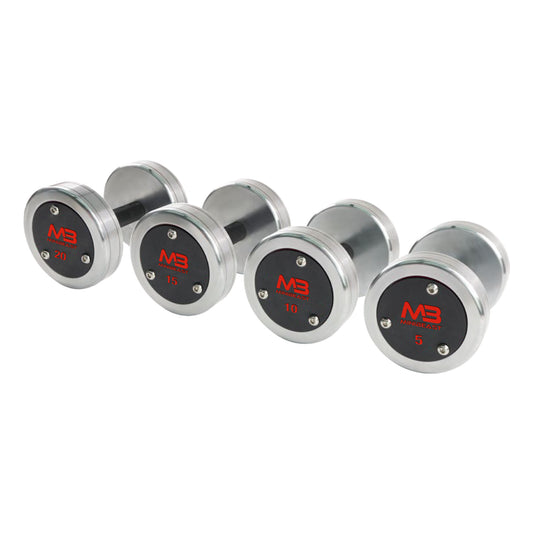
One great option is Minibeast's Signature CNC Stainless Dumbbells. These are those classic metal dumbbells the pros have used for decades. They range from 5 lbs to a hefty 150 lbs.
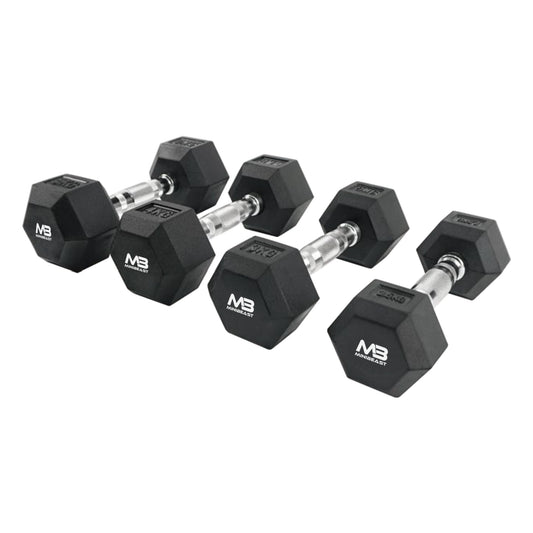
Another option is Minibeast's Rubber Hex Dumbbells. These have hexagonal rubber weights, which makes them great for stacking and easier on floors. They range from 2.5 lbs, which is fantastic for beginners, to a respectable 130 lbs.
Traditional, fixed-weight dumbbells are iconic for a reason. But buying enough of them to cover all the different weights you'll need can cost a lot and take up a lot of space.
What if, instead, you could combine multiple different weights into a single dumbbell design? That's exactly what adjustable dumbbells do.
Adjustable dumbbells are often an economic choice, because they allow you to switch between different weights for different exercises. High-quality adjustable dumbbells let you do this in seconds.
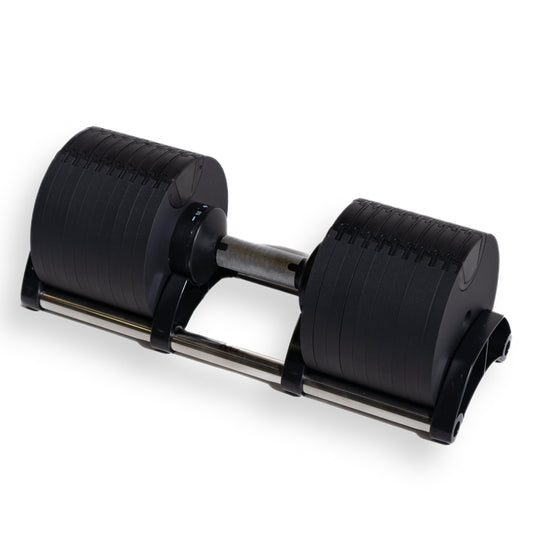
Minibeast's 100 lb Adjustable Dumbbells, for example, let you swap weights with a simple twist of your wrist. The set ranges from 10 lb to 100 lb, giving you a wide range of weights for hundreds of different exercises. And all major parts of the dumbbell are made from cast iron and aluminum for heft and durability.
Conclusion
To pick the right dumbbell weight, consider your fitness goals, what muscle groups you're working, and your current fitness level. You want to be able to perform several reps of an exercise with good form at the very least. It's always good to start lighter and move up to a higher weight if needed.
Frequently Asked Questions
What Is the Ideal Dumbbell Weight for Men?
That depends on your fitness level and the exercise you're doing. For example, beginner upper-body isolation exercises might involve 5-15 lb dumbbells, while lower body lifts might involve heavier 25-40 lb dumbbells.
Is a 20-pound Dumbbell Heavy?
Heaviness is relative. Some people will find a 20 lb dumbbell heavy, and others won't. If you're a beginner, or are working smaller, isolated muscle groups, 20 lbs will likely feel heavy.
Should I Start With 40 or 50 lbs Dumbbells as a Man?
40-50 lb dumbbells are often too heavy for an absolute beginner, especially for isolation exercises and upper-body work. Instead, beginners usually start with 5-15 lb dumbbells for those exercises and 20-40 lbs for lower-body work.
Keep Reading: How Do I Motivate Myself to Workout?
--
Minibeast believes that everyone has the power to evolve into their best self. From state-of-the-art fitness equipment to comprehensive training programs, our brand is built for those who take their goals seriously. Through The Heart of Minibeast, 5% of every order helps feed families in need and support community programs. Get the latest workout tips, product updates, and fitness content by following us on Instagram, Facebook, YouTube, and TikTok.
–
These statements have not been evaluated by the Food and Drug Administration. These products are not intended to diagnose, treat, cure, or prevent any disease. The information provided on this website is for informational purposes only and is not intended as a substitute for professional medical advice, diagnosis, or treatment. Always seek the advice of a qualified healthcare provider with any questions you may have regarding a medical condition or before starting any new diet, exercise program, supplement, or using any fitness equipment or apparel. By using this site and its products, you acknowledge that you do so at your own risk. Use all products only as directed and discontinue use immediately if discomfort or adverse effects occur.