The Ultimate Guide to Choosing the Right Dumbbell Weight

Getting an effective workout requires using the right weight. But that isn't always as easy as it sounds.
We break down the main factors to consider to help you pick the perfect weight for your individual fitness goals.
Key Takeaways
- The correct dumbbell weight depends on your fitness level, fitness goals, and what muscle groups you want to target.
- Larger muscle groups can generally handle heavier weights.
- To build muscle mass and strength, experts usually recommend lifting heavier weights for fewer reps.
- Other fitness goals often involve lifting lighter weights for more reps.
- If you can complete your sets without feeling challenged, it's likely time to increase the weight.
See More: Why Do My Leggings Keep Falling Down? 5 Fixes
Picking the Perfect Dumbbell Weight
Carriejune, founder of Minibeast, says:
"The right weight is one that challenges you without forcing you out of proper form. Finding the right weight can take trial and error, and it's usually better to start too light than too heavy."
When you walk into the gym, one of the first things you usually see is the dumbbell rack. If you're not sure where to start, all those weights can seem a little intimidating.
In reality, they represent opportunity. Or rather, many different opportunities, in the form of hundreds of different exercises that can help you smash your fitness goals.
Now, that doesn't mean you should dive in and pick at random. Choosing the right weight is very important.
Go too heavy, and you risk injury. Too light, and you might not get an efficient workout.
So how do you pick the perfect weight?
There are a few things to consider. One is your current fitness level. Another is your fitness goals.
Once you've established these things, you can approach the dumbbell rack with confidence. You'll be able to pick the perfect weight, no matter what exercise you're tackling or how far you are on your fitness journey.
Then you'll be able to move on to other important questions. Like what type of dumbbells you want to use.
How Much Weight Should I Use?

The golden rule of choosing the right dumbbell weight is actually quite straightforward. You want something heavy enough to challenge you, but not too heavy that you can't perform the exercise with good form.
But why is that?
Well, in order to progress, you need to challenge yourself. If you're lifting a light weight that isn't difficult at all, you probably won't see much progress.
Over time, as your muscles adapt and grow, you need more resistance to keep things challenging. This principle is called progressive overload.
However, you don't want to go too far, too fast. Pick a weight that's too heavy, and you might not be able to complete the exercise without slipping into poor form.
Good form is non-negotiable. It prevents injury, sure, but also makes your workouts more efficient by ensuring you are activating the muscle groups you actually want to target.
One general rule of thumb to check that you're in this sweet spot is to see how challenging a set is. Ideally, you want the final two or three reps of your set to feel really challenging. You should still be able to complete them with proper form across the full range of motion, but you might feel like you are getting close to failure.
Checking this is simple. Pick a starting weight and try a set. If you're unsure about a weight, start lighter.
Too easy? No problem. Consider it a warm-up set. Increase the weight by 2.5 to 5 lbs and try again.
Too heavy? Don't push it. Drop down by 2.5 to 5 lbs.
This trial-and-error system is a tried-and-tested way to find the correct weight and get a solid workout.
Of course, this process can take time. Ideally, you'd like to pick the right weight the first time, or at least close to it. And we haven't specified exactly how many reps you should be aiming for in a set, too.
Fitness Level
Perhaps the most important factor in choosing the right weight is your current fitness level.
Now, we should emphasize the "current." If you used to be a gym rat and could squat twice your body weight but haven't worked out in years, don't jump right back to your old max weight. That's a recipe for disaster.
Instead, carefully consider your current capabilities. It's always better to start on the lighter side and progress to lifting heavier weights if needed (and as you progress). The alternative is injury and burnout.
Beginners
That's especially true if you're an absolute beginner. If you're just starting out with weight training, chances are you'll need to begin with a lighter weight than you think.
It's quite common for beginners to overestimate themselves, and to underestimate how important good form is. Once you spend enough time in the gym, you'll probably see this for yourself.
By lifting lighter weights, you don't just reduce the chance of injury. You give yourself a chance to really learn how each movement works.
By perfecting your form now, you can create a solid foundation that will serve you well when you start advancing up the dumbbell rack. It also lets you build your confidence as you start building muscle.
Another thing to note as a beginner is that different muscle groups can often handle different weights. Larger muscle groups, like your quads and glutes, will likely be able to handle heavier loads than, say, your biceps or shoulders.
Therefore, it's crucial you adjust your weight based on the muscle groups you're working.
With that in mind, let's cover some general guidance.
First, upper body exercises. Think bicep curls, shoulder presses, and rows. Most beginners will need a starting weight around 5 to 10 lbs. For women, it might be 2 to 10 lbs. Men might be able to handle heavier weights, so they could start at 15 lbs.
Now, lower body exercises. Think squats, deadlifts, and hip thrusts. Most beginners should look at 10 to 30 lbs. For women, a good place to start is 10 to 20 lbs. Many men typically start at 20 to 35 lbs.
When exercising your core, it's often a good idea to stick to lighter weights, especially at first. That's because form is particularly important when doing core exercises. Poor form here can strain your lower back, which can be bad news.
Remember, these are just starting points. It's entirely possible that you'll need to start at a higher or lower weight.
That's absolutely fine. You're working out to reach your fitness goals, not anybody else's. So it's vital you choose the weights that are right for you.
Advanced Lifters

If you've been lifting for a while, your main focus should be maintaining progressive overload. As we mentioned, that means gradually increasing the demand you place on your muscles to ensure you're still stimulating muscle growth.
Perhaps the most straightforward way of doing this is by advancing to heavier weights.
If you can complete 12 to 15 sets with good form without feeling like the final few are really challenging, it's likely time to up the weight.
You don't have to go crazy. Increase the weight by 2 to 5% and see how that feels. The idea is consistent progress.
Increasing the weight isn't the only way of increasing the demand on your muscles. You could also do more reps in each set, reduce the rest time between sets, or increase the time your muscles spend under strain.
Age
Another important thing to consider when picking your weights is age. That's not because working out is only for certain people. It's because your body changes with age, and those changes might require slightly different approaches.
For example, as we age, our muscles naturally decline. Experts therefore generally recommend that adults over 45 start with lighter weights.
Similarly, teenagers and kids have bodies that are still developing. Therefore, experts generally recommend starting with lighter weights, too. And doing so under the supervision of an adult can help you ensure you're sticking to proper form.
Fitness Goals
Ultimately, the choice of dumbbell boils down to the same thing. Start at the weight that is right for you, and advance from there.
But where, exactly, are you advancing to?
Another major factor to consider when picking your dumbbell weight is your fitness goals.
If you've ever looked at exercise programs, you'll have seen how varied they can be. That's because different approaches are better suited for different fitness goals.
Lighter Weights
In many cases, lighter weights might actually be more appropriate. They're often best for people who are exercising for general health, functional strength, muscle endurance, and weight loss.
Lighter weights are also great for people recovering from injury.
Here, the general idea is often pairing lighter weights with more reps. A set of 15 to 20 reps with a moderate weight will get your heart pumping and build stamina. It's also easier on your joints and body in general than pushing extreme weights.
Heavier Weights
If your goal is muscle growth, you'll need to lift heavy dumbbells for fewer reps. A typical set in strength training is usually between 8 and 12 reps. And remember, those last few reps should be a real challenge.
Bonus: How Many Days a Week Should I Work Out?
What Dumbbells Should I Use?
By now, you should have a better idea of what dumbbell weights you should use. But that still leaves one question.
What dumbbells should you use?
That isn't a trick question. There are actually two main types of dumbbells.
Fixed-Weight Dumbbell Set
The traditional dumbbell is called a fixed-weight dumbbell.
Fixed dumbbells are, well, fixed. Each one is a specific weight. The weights are permanently attached to the handle.
If you want to change weight, you need to use a different dumbbell.
There are plenty of benefits to this. Fixed-weight dumbbells are often quite durable. With a good rack, they're pretty much always ready to go.
Not all fixed dumbbells are the same.
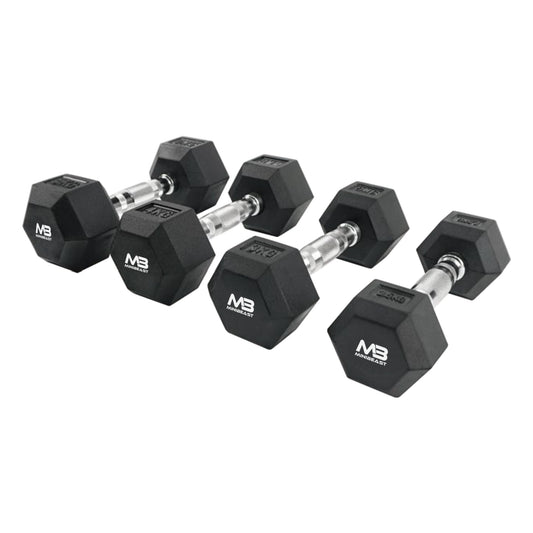
Some have rubber weight plates in a hexagon shape for stacking and stability. Minibeast's Rubber Hex Dumbbells are a great example. They range from 2.5 lb to 130 lb.
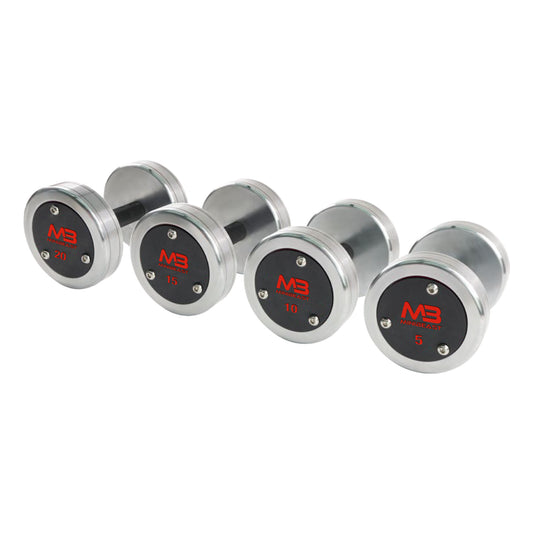
Others, like Minibeast's Signature CNC Stainless Dumbbell, have that classic metal look. They range from 5 lb to 150 lb.
Adjustable Dumbbells

Traditional dumbbells are fantastic. That's why they've been around so long, and remain a staple in gyms.
But there are some downsides. For one thing, a full set can take up a lot of space. And buying all those dumbbells can seriously strain your wallet.
If you're building a home gym on a budget, you might want an alternative. That alternative is a set of adjustable dumbbells, which also lets you have the perfect amount of weight for your home setup.
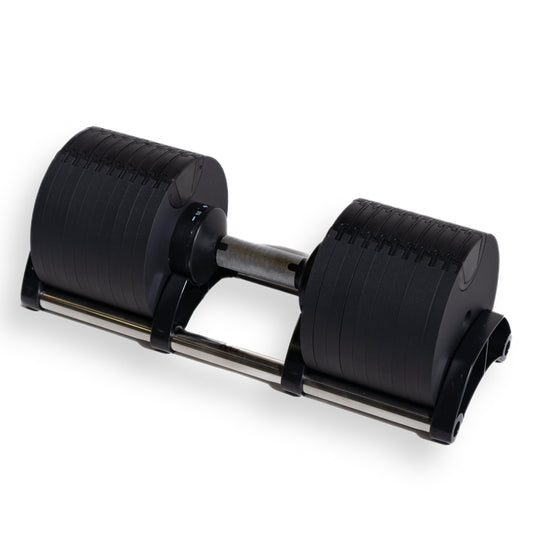
Adjustable dumbbells allow you to increase or decrease the weight attached to the handle. Different models have different mechanisms for doing this, from basic clips that hold weight plates onto the handle to advanced twist-lock mechanisms that can swap out weights in seconds.
Minibeast's MB Pro Adjustable Dumbbell is the latter. The adjustment system lets you swap weights, from 10 lb to 100 lb, with a quick twist of the handle. And a unique stress-bearing structure ensures that this adjustment system and the handle never bear force.
Meanwhile, the major parts of the dumbbell are crafted from cast iron and aluminum for further durability. This adjustable dumbbell set is designed specifically to feel like the traditional heavy-duty dumbbells you'd find at your local gym. Just without the space footprint and price tag.
Conclusion
To pick the right dumbbell weight, you need to consider your fitness level and your fitness goals. The idea is to choose a weight that is challenging but not so difficult you can't complete your workout without slipping into bad form.
Frequently Asked Questions
What Is a Good Dumbbell Weight for a Beginner?
That depends on your strength and what muscle groups you want to exercise. Generally, 2.5 to 10 lbs is a good starting range for upper body exercises, and 10 to 20 lbs for lower body exercises.
Is a 20 lb Dumbbell Good for Beginners?
A 20 lb dumbbell is a great starting weight for many beginners training larger muscle groups. But it's likely too heavy for smaller muscle groups if you're starting out.
Should I Get 25 lb or 30 lb Dumbbells?
That depends on your fitness level, fitness goals, and what muscles you want to target. You should choose a weight that is challenging but not so difficult that you can't complete your exercises without good form.
Keep Reading: Do Fat Burners Truly Work?
--
Minibeast believes that everyone has the power to evolve into their best self. From state-of-the-art fitness equipment to comprehensive training programs, our brand is built for those who take their goals seriously. Through The Heart of Minibeast, 5% of every order helps feed families in need and support community programs. Get the latest workout tips, product updates, and fitness content by following us on Instagram, Facebook, YouTube, and TikTok.
–
These statements have not been evaluated by the Food and Drug Administration. These products are not intended to diagnose, treat, cure, or prevent any disease. The information provided on this website is for informational purposes only and is not intended as a substitute for professional medical advice, diagnosis, or treatment. Always seek the advice of a qualified healthcare provider with any questions you may have regarding a medical condition or before starting any new diet, exercise program, supplement, or using any fitness equipment or apparel. By using this site and its products, you acknowledge that you do so at your own risk. Use all products only as directed and discontinue use immediately if discomfort or adverse effects occur.