5 Easy At-Home Stretches for Your Glutes

Weak or tight glutes can negatively affect many other parts of your body, from your ankles to your back. We break down some effective stretches to help you keep your glutes flexible and functional.
Key Takeaways
- Your glutes are involved in many movements, so tightness can lead to a wide range of issues.
- Static stretches can help relieve glute tension and tightness and enhance glute flexibility and hip mobility.
- Effective exercises include pigeon pose, four-figure stretch, and glute twist.
- Try to stretch consistently a few times per week.
- A glute-focused workout program can help you work on your glute strength.
See More: How Long Should I Be Working Out at the Gym For?
How Can I Stretch My Glutes?
Carriejune, founder of Minibeast, says:
"Targeted stretches are a fantastic way to enhance glute flexibility, mobility, and function. Combine stretches with resistance training for the most effective results."
Your glutes are the largest muscle group in your body. Tight glutes can therefore cause a whole chain of problems, from an overworked back to tense hamstrings to joint issues and more.
Fortunately, stretching your glutes is easier than you might think. You don't need complicated techniques, loads of time, or specialized equipment.
Regular glute stretches are a great way to relieve tension, improve mobility, and support your overall fitness and wellness. Stretching is particularly useful if you spend most of your day sitting at a desk, as many of us do.
We'll break down the biology behind your glutes, what makes them tighten up, and five simple stretches you can do to loosen things up.

What Are My Glute Muscles?
Your glutes are actually a group of three distinct muscles. Together, these gluteal muscles help power and control pretty much every lower-body movement, from walking to standing to climbing stairs.
What Is the Gluteus Maximus, Gluteus Medius, and Gluteus Minimus?
The gluteus maximus is the largest of your three glute muscles. It's the main driver of hip extension.
The gluteus medius is smaller. It sits on the outer surface of your pelvis and is responsible for hip abduction, the motion of lifting your leg to the side.
The gluteus minimus is the smallest of the three glute muscles. It sits underneath the other two, deep inside your pelvic region. It helps stabilize your pelvis.
Why Are My Glutes Important?
Your glutes are one of the most important muscle groups in your body. As we already mentioned, they're responsible for practically every lower-body movement.
Your glutes also keep your hips and pelvis stable during movement. They're vital for maintaining proper balance and posture.
Strong glutes help enhance athletic performance and can reduce the risk of injury. Weak or tight glutes can lead to the opposite.
Why Do My Glutes Feel Tight?
Tight glutes are usually caused by multiple factors.
Sitting is one. Prolonged sitting can cause glute muscles to become weaker and tighter.
Posture is another. Bad posture can undermine glute activation, causing your glutes to become weaker and tighter. If your pelvis is misaligned, it can force your glutes to stretch abnormally, causing tightness.
Overuse due to repetitive activities, including exercise, can also cause tightness. If you've ever finished a long cardio workout, you might have noticed this.
Age can also affect things. As you get older, muscle elasticity naturally decreases. That can contribute to tight glutes.
Bonus: How Much Does a Gym Membership Cost? What to Consider
How Do I Stretch My Glutes?
There are plenty of ways to address tight glutes. Stretching is just one technique among many.
For example, strengthening your glutes is often worthwhile. Hip mobility work is also important because your hips and glutes are closely linked. The 90/90 hip stretch is a great way to enhance hip rotation mobility.
A holistic approach that combines glute stretches with other techniques is often the most effective at keeping your glutes healthy and happy.
When it comes to stretches, there are several basic principles to consider.
First, make sure to warm up before stretching, especially if you're stretching early in the morning. A short walk or some light movement should be enough. The idea is to wake up your muscles and get them ready for the stretches ahead.
Second, don't push yourself through pain. You should feel tension when stretching, but not pain. Consistent, gentle stretching is often better than intense, painful stretches that risk injury.
Third, remember to breathe. Deep, regular breaths help ease muscle tension.
There are two kinds of stretches: static and dynamic. Dynamic stretches are active movements. They're great for boosting blood flow and preparing your muscles for activity.
Static stretches are when you hold a muscle in a lengthened position. They're great for recovery, flexibility, and range of motion.
You don't need to hold a static stretch forever. 20-30 seconds per muscle is often enough.
Try not to bounce during a static stretch. It increases the risk of injury.
Finally, be consistent. Try to incorporate stretches into your normal fitness routine. Many people aim to stretch 3-4 times per week. Just as with any other form of exercise, consistent, effective training is the way to get results.
Just don't forget to wear scrunchy, pliable leggings that help you maximize your stretching.

What Are 5 Easy Glute Stretches?
Now that we've broken down some of the basics, let's cover five fantastic glute stretches.
#1. How to Do a Lying Figure-Four Stretch
The figure-four stretch is great for targeting your deep glute muscles and piriformis. That's a small muscle deep in your booty that helps stabilize your hips.
To start, lie on your back. Keep your knees bent and your feet flat on the floor.
Next, cross your right ankle over your left thigh. Place it just above your left knee.
Then place your hands on your left leg and gently pull it up toward your chest, lifting your left foot off the floor.
Once you feel the stretch in your right glute and right hip, hold for 20-30 seconds. Return to the starting position and repeat the movement on your other leg.
If you can't (or don't want to) lie down, you can also do a seated figure-four stretch.
As you might be able to guess, it starts from a seated position. Sit in a chair with your feet flat on the floor. Place your left ankle over your right knee.
Slowly hinge forward at your hips, keeping your back straight and shoulders relaxed. When you feel the stretch in your left glute and left hip, hold for 20-30 seconds.
Return to the starting position and switch sides.
#2. How to Do a Standing Glute Stretch
You can also do the figure-four stretch while standing.
Start by standing with your feet hip-width apart. Lift your left foot and place your ankle above your right knee.
Bend that right knee, the knee of your standing leg, and lower your hips back. Imagine you're about to sit down. Keep going until you feel the stretch in your left glute, then hold for 20-30 seconds.
If you feel unsteady, place your hand on a wall or hold onto something sturdy for balance.
#3. How to Do Pigeon Pose
Pigeon pose is a classic yoga technique that helps stretch your glutes, open your hips, and relieve tension in your hip flexors and lower back.
Start with your hands and knees on the ground, on all fours. Slide your right leg forward. Your right knee should go toward your right wrist, while your right ankle should go toward your left wrist.
Next, slide your left leg back. Keep that left leg straight. The top of your foot should be facing down.
Make sure to keep your hips square. If your right hip lifts up, that's fine. Put a yoga block (or something similar) underneath it for support.
Once your back leg is fully extended, start walking your hands forward. As they move forward, lower your upper body. The aim is to get your upper body on the floor, over your front leg. Keep your spine neutral, though.
Go as far as you comfortably can, and hold for 20-30 seconds. Then return to the starting position and switch sides.
Here, your front leg gets the glute stretch. Your back leg gets a good hip flexor stretch.
#4. How to Do a Knees-to-Chest and Knees-to-Shoulder Stretch
One of the simplest stretches involves pulling your knees up to your chest or shoulder, depending on the part of your glutes you want to target.
Start by lying flat on the floor with your legs extended out. Pull both of your knees up and into your chest with your hands until you feel the stretch.
If you want to shift or intensify the stretch, hold one knee in while the opposite knee extends out.
Alternatively, pull one knee toward the opposite shoulder while the other leg is extended and relaxed.
#5. How to Do a Glute Twist
A glute twist, or seated spinal twist, is a great way to lessen tension in your lower back and glutes.
Start by sitting with your legs extended in front of you. Sit tall and keep your spine straight.
Lift your left leg, bending the knee. Place your left foot on the outside of your right leg. Plant that left foot flat on the floor.
Hold your left knee with your right arm. Put your left arm out behind you for support.
Start rotating your torso to the left. When you feel the stretch in your left glute, hold for 20-30 seconds. Repeat on the other side.
How Can I Strengthen My Glutes?
As we mentioned, stretching is just one part of the solution. It's also important to keep your glutes strong and capable. Sometimes glute issues are due to weakness, not tightness.
If you want to work on your glutes, a targeted workout program is a great place to start.
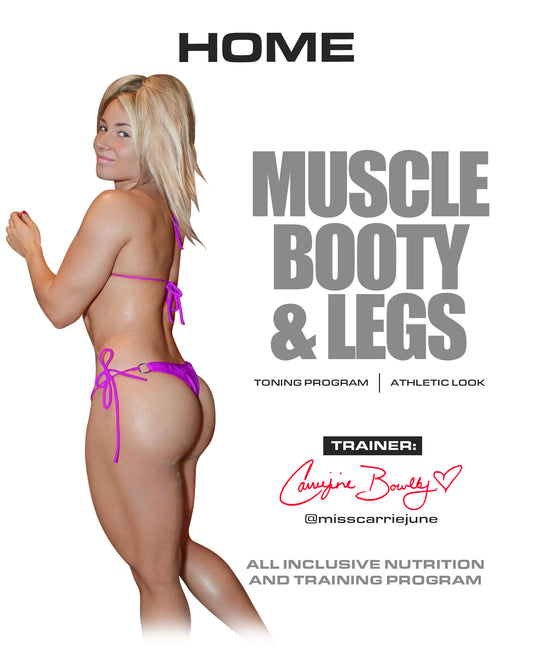
Minibeast's Booty & Legs Workout Program teaches you the same workouts Carriejune has used for years to build a big booty and sculpted quads. You get 8 weeks of workouts, tailored meal plans, example diets, recipes, personal tips, and much more.

Conclusion
Tight glutes can cause all kinds of problems. Stretching your glutes is a great way to address tightness and enhance mobility, flexibility, and function. Stretch a few times a week, holding each movement for 20-30 seconds.
Frequently Asked Questions
How Do You Release Tight Glutes?
Targeted stretches are a great way to release tightness and relieve tension in your glutes. Effective movements include the figure-four stretch and pigeon pose.
How Do You Release Deep Gluteal Muscles?
One way to release deep gluteal muscles is with targeted stretches, like the figure-four stretch or knee-to-shoulder stretch. Some people press their glutes against a tennis or massage ball to relieve tension.
How to Tell If Your Glutes are Tight or Weak?
To determine if your glutes are tight or weak, pay attention to your movement and how you feel when you exercise. If you have a reduced range of motion or feel like your glutes go numb when sitting, your glutes might be tight. If your knees cave in when standing on one leg or your hamstrings take over during glute bridges, your glutes might be weak.
Keep Reading: How Much Does the Average Hex Deadlift Bar Weigh?
--
Minibeast believes that everyone has the power to evolve into their best self. From state-of-the-art fitness equipment to comprehensive training programs, our brand is built for those who take their goals seriously. Through The Heart of Minibeast, 5% of every order helps feed families in need and support community programs. Get the latest workout tips, product updates, and fitness content by following us on Instagram, Facebook, YouTube, and TikTok.
–
These statements have not been evaluated by the Food and Drug Administration. These products are not intended to diagnose, treat, cure, or prevent any disease. The information provided on this website is for informational purposes only and is not intended as a substitute for professional medical advice, diagnosis, or treatment. Always seek the advice of a qualified healthcare provider with any questions you may have regarding a medical condition or before starting any new diet, exercise program, supplement, or using any fitness equipment or apparel. By using this site and its products, you acknowledge that you do so at your own risk. Use all products only as directed and discontinue use immediately if discomfort or adverse effects occur.